A buyer moving out of the South End called last spring with a clean question. Zillow said Hingham's typical home was about $1.3 million. Redfin's most recent monthly median was under a million. Movoto's July list-price median was $2.19 million. Which number, she asked, should she actually plan around?
None of them, on their own. Hingham in 2026 is not one market with a single center of gravity. It is two markets stacked on top of each other, and the price a buyer pays depends less on square footage than on which of the two she is shopping in and how close the house sits to a single dock at Hewitts Cove.
The friction that shows up at the offer table
The transaction-level surprise for buyers coming from Boston is speed, and it is not evenly distributed. Hingham is very competitive, homes sell in 18 days, and many get multiple offers, some with waived contingencies. Darleen Lannon's brokerage data puts the 2025 median days to offer at 10 days. That number is an average, and averages are the enemy of good bidding strategy. Homes in the middle band, ready-to-move colonials priced between roughly $1.2M and $1.9M, tend to clear inside a week with escalation clauses. New construction and true waterfront can sit longer because the buyer pool is smaller and inspection concerns are higher. Bringing a Boston-style offer with a long financing contingency to a mid-band Hingham house is the most common way a well-qualified buyer loses her first three tries.
Reading the median for what it actually is
Here is the number that reframes everything. Homes under $1M are becoming a rarity in Hingham, while the luxury segment over $2M now makes up nearly 30% of all closings. A decade ago that share was under two percent. The median has drifted up because the bottom of the market has been renovated, torn down, or absorbed into the luxury tier, not because a typical Hingham house has doubled in utility.
The distance between how services report the market tells the same story from the other side:
| Source | Metric | Figure | Window |
|---|---|---|---|
| Redfin | Median sale price | $950K | September 2025 |
| Darleen Lannon / MLS | Median sale price | $1.384M | Full-year 2025 |
| Realtytrac | Median estimated value | $1.318M | 2026 |
| CommunityScale | Typical home value | $1.28M | 2026 |
| Movoto | Median list price | $2.19M | July 2026 |
The gap between the sale-side numbers and the list-side number is not a data error. It is the market telling you what is on the shelf right now versus what has actually cleared over the last year. Listings skew toward the upper tier because that is where inventory is turning slower and stacking up on the market. Sales skew lower because the middle band, when it appears, disappears in ten days.
Why the ferry is the real price gradient
Portals price Hingham as a South Shore suburb. The MBTA prices a portion of it as a Boston commuter product, and the market has followed the MBTA.
The F1 ferry from Hewitts Cove runs year-round to Rowes Wharf in downtown Boston. A one-way fare is $9.75, and Hingham/Hull passes are also valid on the subway, bus, and Commuter Rail Zones 1A-5. The terminal has 1,726 total parking spots at $2 daily or $35 monthly. For a household with one partner working in the Financial District or Seaport, that is a rounding error against a Beacon Hill mortgage.
The dock itself is under active work. As of late spring 2026, passengers should allow extra time to park and access the ferry in Hingham due to work being done for the new dock, and Route 220 buses are bypassing the shipyard and remaining on Route 3A. That is short-term friction with long-term implications: the state is putting capital into the terminal, and Hingham is boosting the district by collaborating with the MBTA to enhance the Shipyard's links to Boston and Hingham Square, with recent announcements including expanded MBTA Commuter Ferry capacity to Boston and regular bus service connecting the ferry terminal to Hingham Square.
A buyer comparing a colonial in West Hingham within walking distance of the terminal to a nearly identical colonial in South Hingham near the Route 3 interchanges is not comparing two houses. She is comparing a hybrid urban-suburban product to a pure suburban one. The price gap that shows up in the listing photos, which look almost identical, is the ferry premium.
Crow Point is priced as a separate town
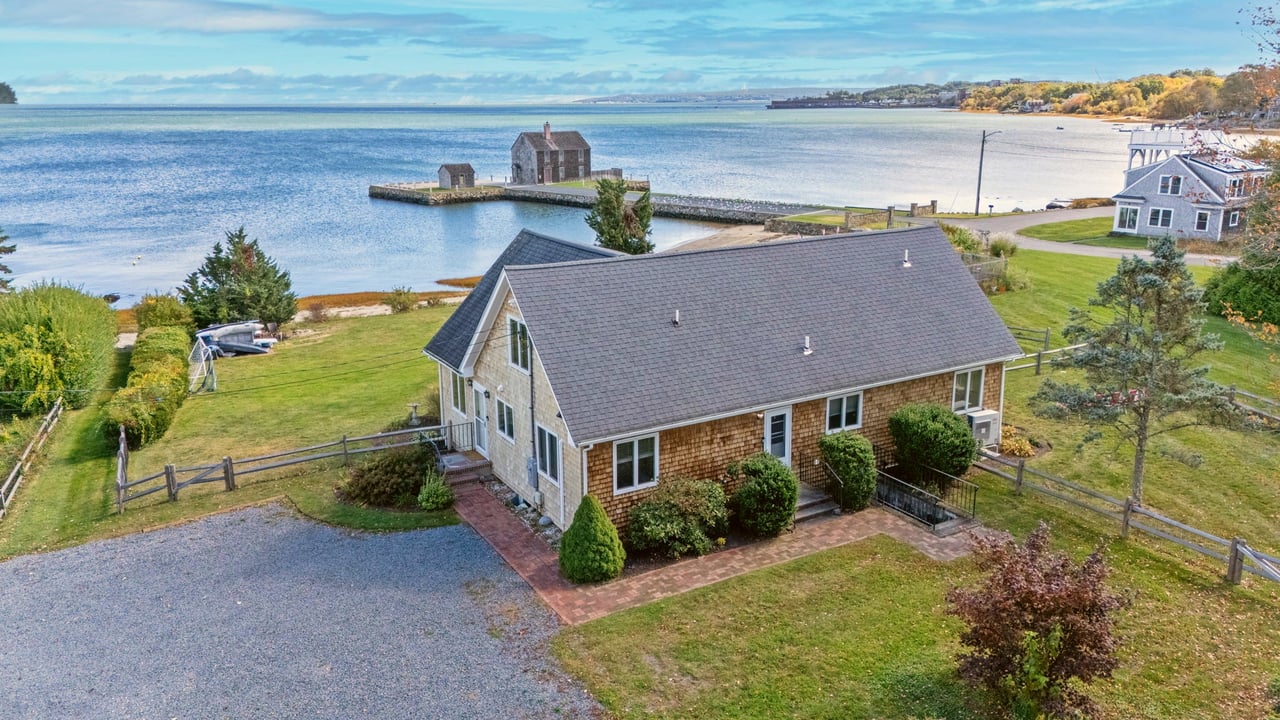
Crow Point sits on the western tip of Hingham, wrapped by water on three sides, and it trades on its own logic. The median home price in Crow Point is $1,595,000, and homes there sell after an average of 34 days on market, with the median sale price over the last 12 months at $1,404,500, up 6% from the previous 12-month period. Days on market are longer than the town average because the buyer pool for waterfront-adjacent homes is smaller and more selective, not because demand is soft.
What a buyer is actually purchasing inside Crow Point varies more than the median suggests. A modest fee lets homeowners join the neighborhood association for access to the private beach at the end of Kimball Beach Road, and a slightly higher fee adds access to the boat dock at the end of Foley Beach Road along with the beach. Direct waterfront lots with deep-water docks trade well above $5M. Interior lots without views or association access trade closer to the general Hingham median. The 15-minute walk to Foster Elementary and the Hingham Shipyard ferry sits inside the same neighborhood, which is why the same street name can appear next to a $900K teardown and a $4.5M new build in the same twelve-month window.
The Shipyard is the amenity story buyers underweight
The retail node at the water is a live one, not a bedroom-community placeholder. The Launch at Hingham Shipyard, managed by Samuels & Associates, holds more than forty tenants including Alma Nove, Wahlburgers, and Ulta Beauty. Cohasset favorite Salty Days Fish Co. is launching a full-service restaurant just steps from the water in the space formerly occupied by Boathouse Bistro, with a full bar, outdoor patio dining, and streamlined takeout. The free Friday concert series, in its fifteenth year in 2026, runs at the amphitheater behind 18 Shipyard Drive from late June through late August.
Two things follow for a buyer. First, the walkability score inside a two-mile radius of the terminal is closer to a Boston streetcar suburb than a South Shore town. Second, more retail energy is coming. The town's draft Economic Development Strategic Plan discusses mixed-use possibilities for the MBTA ferry parking lot and 29 Shipyard Drive, including retail, entertainment, a hotel, residential development, community recreation and green space, and structured parking. A house bought today near the terminal is being priced against tomorrow's density, not today's.
What this means before you write an offer
The buyer coming from a portal comparison should ignore the town-level median and ask three narrower questions. What is the sale-price band for houses within a fifteen-minute walk of Hewitts Cove or downtown Hingham? What is the band for South Hingham near the office campuses and Route 3? And what is the band for water-access neighborhoods like Crow Point with deeded association rights? Those three bands do not overlap cleanly, and mixing them produces the phantom median that has been confusing out-of-town buyers all year.
FAQ
Is the Hingham market softening? Redfin's September 2025 monthly reading showed a year-over-year decline against an unusually strong 2024 comp, while full-year MLS data still shows growth. A single month against a peak month is a small sample; the annual trend is the more honest read.
How does the ferry differ from the Greenbush commuter rail? Both run to Boston. The ferry lands at Rowes Wharf steps from the Financial District. Greenbush lands at South Station. Buyers whose office is in the Seaport or downtown tend to pay a premium for the boat; buyers headed to Back Bay or Cambridge often prefer the train.
Are new listings still moving in ten days? The middle band is. Homes above $2.5M and true waterfront routinely sit thirty to ninety days.
Should I wait for the Shipyard redevelopment to be decided before buying nearby? The plan is in draft form and any zoning changes will move on their own timeline. Buyers who want the area's future upside are typically buying now; buyers who want certainty about density are typically waiting.
Working through a comparison like this is exactly the kind of pricing question worth a longer conversation before you write an offer. Reach out to Matthew Winterle for a market read tailored to the streets, and the price bands, you are actually shopping.